
StakeStone Explained: Stunning Guide to the Best STO.
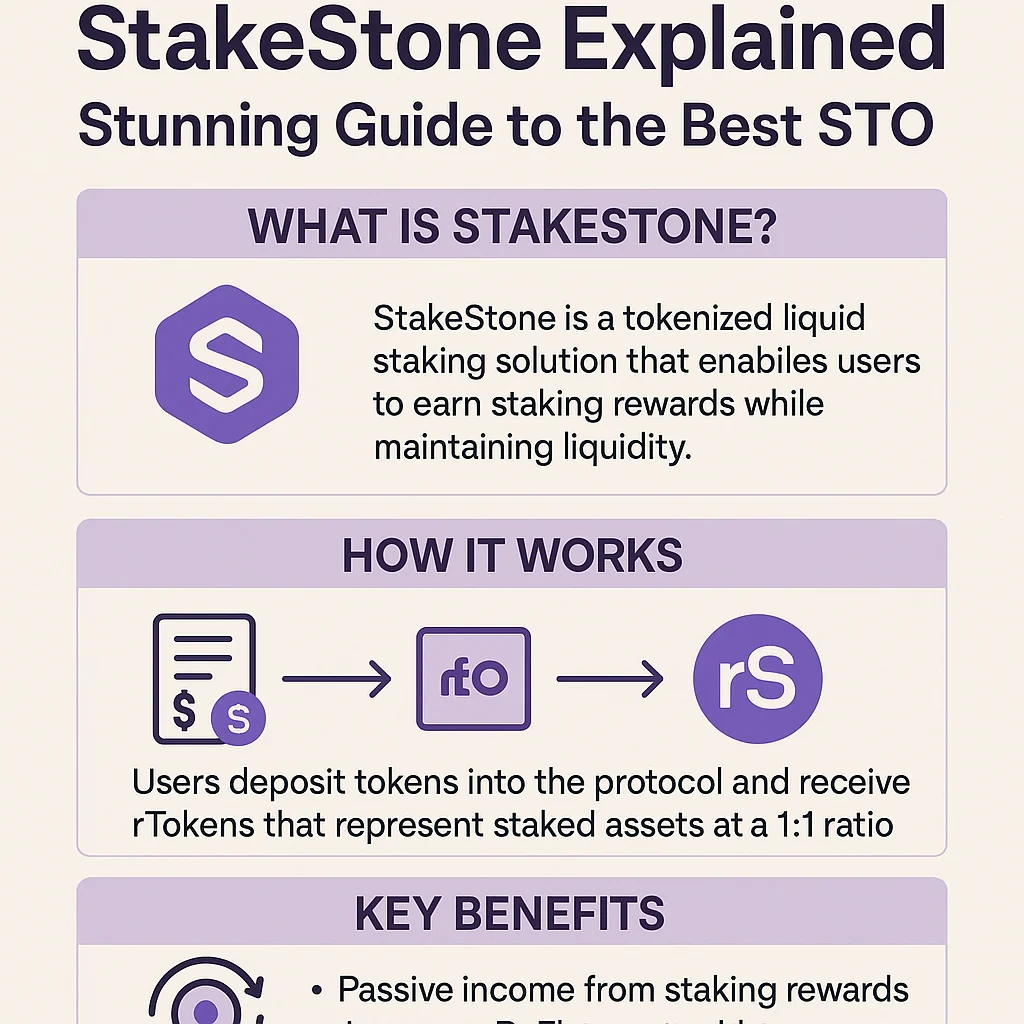
Article Structure

Instead of staking ETH in a single protocol and locking it, STO lets users hold a token that tracks a diversified basket of yield sources. The protocol aims to spread risk across providers and keep the token easy to move and use across DeFi platforms.
StakeStone in Simple Terms
StakeStone works as a “liquid yield router.” Users deposit assets such as ETH or stablecoins into StakeStone. In return, they receive STO, which represents a claim on a pool of staked and restaked assets in the background.
As those underlying assets generate staking rewards, the value of STO increases over time. In practice, 1 STO should represent a growing amount of the base asset over the long run, similar to how many liquid staking tokens grow in value relative to ETH.
How StakeStone (STO) Works Under the Hood
StakeStone uses a modular structure that connects to different yield sources rather than running a single validator set. This structure tries to keep yields competitive and spread risk across providers.
Core Components of StakeStone
The protocol relies on a few key building blocks that work together to issue STO and route yield.
- Vaults or Strategies: Smart contracts that hold user deposits, stake them, or restake them across partner protocols such as liquid staking tokens (LSTs) and restaking platforms.
- STO token: An ERC-20 token (and often omnichain representation) that tracks a share of the total assets held inside StakeStone vaults.
- Rebalancing logic: Rules or governance processes that decide how deposits move between strategies, reacting to yield, risk, or new partners.
- Bridging / omnichain layer: Infrastructure that lets STO move across chains so users can use it in DeFi on different networks.
In a simple scenario, a user deposits 10 ETH. The protocol stakes that ETH through one or several LST providers, may restake it on a security-sharing layer, and issues STO back to the user. Over time, the vault earns rewards, and the STO token grows in value per unit against ETH.
Step-by-Step: What Happens When You Get STO
To see how the process looks from a user perspective, consider the basic steps involved.
- Deposit assets: You send ETH or another supported asset to the StakeStone contract or frontend.
- Receive STO: The protocol mints STO to your wallet based on the current exchange rate between STO and the deposit asset.
- Routing into strategies: Your deposit flows into staking and restaking strategies that earn yield.
- Yield accrues: Rewards from validators and partner protocols increase the total pool of assets over time.
- Exchange rate shifts: The value of 1 STO in terms of ETH rises as the pool grows, reflecting earned yield.
- Use or redeem: You can hold STO, use it in DeFi, bridge it, or redeem it back into the base asset (subject to liquidity).
This process aims to remove the daily effort of chasing yields or switching LST providers, while still keeping your position liquid in the form of a single token.
What Makes StakeStone Different from Regular Liquid Staking?
Classic liquid staking protocols issue a token that tracks a single validator set or provider. StakeStone extends this idea with diversification, restaking access, and omnichain support.
| Feature | StakeStone (STO) | Typical LST (e.g., single protocol) |
|---|---|---|
| Yield sources | Multiple LSTs and restaking strategies | One validator set or single pool |
| Risk spread | Diversified across providers and strategies | Concentrated in one protocol |
| Token nature | Yield-bearing token with dynamic backing | Yield-bearing token with static backing |
| Use across chains | Built to be omnichain through bridges | Often native to a single chain |
| Strategy updates | Can rebalance into new partners or yields | More tied to the original protocol design |
For a holder, this means STO acts as an “index-like” yield token. Instead of picking between several LSTs and restaking options, you can hold one asset that already bundles them.
Key Use Cases for STO
STO is mainly useful for users who want staking yield and DeFi flexibility without managing several positions manually.
1. Passive Yield with Liquidity
STO gives exposure to staking yields with no need to operate validators or pick single providers. You hold one token while the protocol manages staking and restaking in the background.
For instance, a long-term ETH holder could convert a portion of their holdings into STO, keep earning yield, and still keep the option to trade or move capital at any time instead of running their own node.
2. Collateral in DeFi
Because STO is an ERC-20 style asset, protocols can list it as collateral for lending, margin, or structured products. Users can earn staking yield on STO while also borrowing stablecoins against it, or joining liquidity pools.
A trader could use STO as collateral on a lending platform: they deposit STO, borrow USDC against it, and still benefit from the yield that accrues in STO itself.
3. Diversified Staking Exposure
Single LST positions tie your fate to one protocol. StakeStone tries to soften this by spreading exposure across different partners and chains.
While this does not remove smart contract or market risk, it can moderate the impact if one provider underperforms or suffers an incident, compared to a fully concentrated position.
4. Omnichain Liquidity
STO aims to move easily between chains through supported bridges and messaging layers. This helps users chase DeFi opportunities without unwinding their staking positions each time they change chains.
For example, you might get STO on Ethereum, then bridge a portion to a Layer 2 to join a yield farm or liquidity pool that accepts STO as input, while your base position keeps earning staking rewards.
Main Benefits of StakeStone (STO)
StakeStone offers several advantages for users who want yield, composability, and diversification in a single asset.
- Yield aggregation: Access multiple yield sources from a single token instead of juggling several positions.
- Diversified backing: Spread smart contract and provider risk across different partners.
- Liquid by default: STO remains transferable and tradable, unlike native staked ETH locked at the validator level.
- Composability: Use STO in DeFi for lending, liquidity, and structured products while you earn yield.
- Omnichain reach: Move STO across chains instead of unwinding and restaking each time.
These traits appeal to both passive holders and active DeFi users, since both groups can benefit from compounding rewards and capital efficiency.
Risks and Points to Watch
Like any DeFi product, StakeStone carries risks. STO holders should understand these before committing large capital.
Smart Contract and Protocol Risk
StakeStone uses smart contracts plus external partners such as LSTs, restaking platforms, and bridges. A bug, exploit, or design flaw in any of these layers can cause loss of funds or depegging of STO against its target asset.
Audits and security reviews reduce but do not erase this risk. Users should check security reports, code repositories, and community discussions before large deposits.
Dependency on External Yield Sources
STO yield depends on the performance of underlying staking and restaking strategies. If these yields fall, or if a partner protocol changes its rules, STO returns may drop or shift over time.
Protocol governance may respond by rebalancing into new strategies, but this process is not instant and can face liquidity or capacity limits.
Liquidity and Market Risk
To exit STO quickly at fair value, you need liquid markets or deep redemption routes. In early stages or during stress events, on-chain pools may be shallow, spreads can widen, and redemptions may take longer or cost more in slippage.
Traders who use high leverage against STO should keep this in mind, since a temporary discount or liquidity squeeze can trigger liquidations.
Bridge and Omnichain Risk
Bridges that move STO between chains add another attack surface. A bridge exploit may freeze, steal, or mis-report balances of STO on a given chain, even if the main StakeStone contracts remain safe.
Users who value safety more than cross-chain activity may prefer to hold STO on the origin chain or rely on the most battle-tested bridges only.
Who Might Consider Using STO?
StakeStone is not a beginner product, but it can be useful for people with some DeFi experience who want yield plus flexibility.
- Long-term ETH holders who want staking rewards without running nodes and with easier access to DeFi.
- DeFi farmers who look for yield-bearing base assets to increase their capital efficiency in strategies.
- Funds and treasuries that prefer diversified exposure to staking across providers instead of picking a single LST.
- Cross-chain users who move capital between chains and want to keep an underlying yield position intact.
New users should start small, learn how STO behaves in their chosen DeFi platforms, and only scale once they understand the mechanics and risks.
How to Research StakeStone Before Using It
Before interacting with any staking aggregator, a quick research checklist helps protect capital and set realistic expectations.
- Read the official documentation, including sections on strategy allocation and risk.
- Review smart contract audits, bug bounty programs, and any security disclosures.
- Check which LSTs, restaking platforms, and bridges are integrated and how much is allocated to each.
- Look at STO liquidity on major DEXs and lending protocols on the chains you use most.
- Follow community channels and forums to see how the team communicates during upgrades or incidents.
This basic due diligence can help you decide whether STO aligns with your risk tolerance, time horizon, and strategy as a crypto user.
StakeStone as a Yield Aggregation Layer
StakeStone (STO) serves as a yield-bearing token that routes deposits into multiple staking and restaking strategies while keeping liquidity and DeFi utility. It brings together ideas from liquid staking, restaking, and omnichain design in a single asset that users can hold, trade, and use as collateral.
For those who want diversified staking exposure without juggling multiple LSTs and bridges by hand, STO offers a simple entry point, as long as users stay aware of smart contract risk, external dependency, and liquidity limits.